




What Is Lifecycle Thinking and Does It Apply to My Business?
Lifecycle thinking (LCT) considers the environmental and socio-economic impacts of the entire lifecycle of a product or service from cradle to grave/cradle. At each stage factors such as:
- greenhouse gas (GHG) emissions
- creation of air, land and water pollutants
- water usage
- fertiliser and pesticide use
- biodiversity loss
- land systems change
- resource scarcity
- creation/disposal of novel entities (eg synthetic chemicals/plastic)
are considered to understand their impact and enable action to lessen negative consequences and enhance positive actions. Whatever your business, LCT will be relevant.
What Stages Does a Product Go Through?
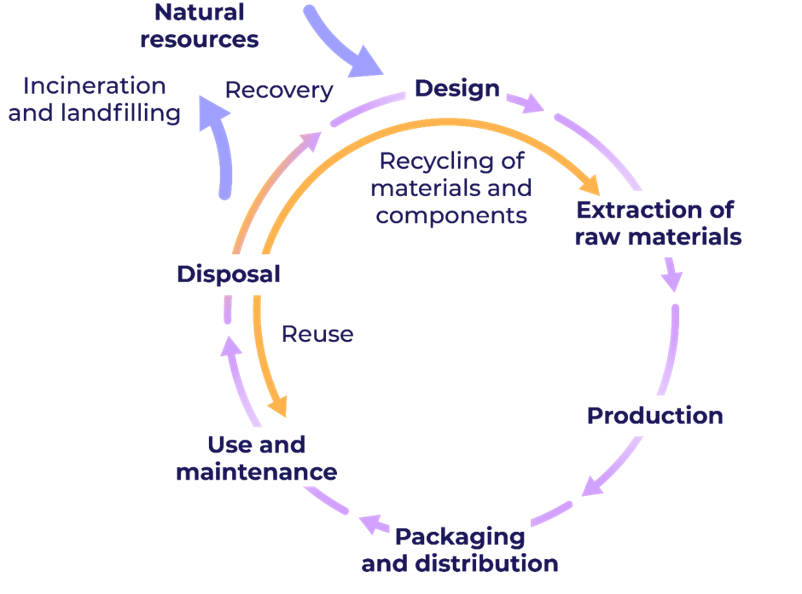
This graphic, which has been adapted from the Life Cycle Initiative, outlines the different stages of a product’s lifecycle. Each stage will have different environmental impacts which can also affect humans.
How Can Design and Raw Materials Reduce Impact?
Significant impacts can be reduced at the design stage. Goods that are designed to last and to be easily repairable should have a lower impact. What the goods are made from is also relevant and whether recycled/reclaimed components are used rather than raw materials which might be mined.
Mining for raw materials can create huge quantities of waste. For example, the Environmental Protection Agency in the USA has outlined how hundreds of tonnes of ore are handled to produce a single tonne of copper. The mining process is environmentally significant as it can affect biodiversity and cause toxic elements to leach into soils and watercourses, not to mention the impact on climate change if fossil fuels are used in this industrial process.
LCT can enable consideration of the extraction process when products are designed so that the environmental harm during the mining process is minimalised which could include the use of renewable energy rather than fossil fuels. Furthermore, substituting the copper for a different material could avoid the need to mine in the first place. Alternatively, steps could be taken to use recycled content.
What Changes at Production, Packaging and Distribution?
Depending on the industry, the production stage could entail the use of fossil fuels and water abstraction. LCT can lead to energy audits to make efficiency savings and consideration of a switch to renewable energy which will reduce GHG emissions and local air pollutants such as NOx, SOx and VOCs. Analysis on the use of water could result in water efficiency savings and the use of technology to perhaps harvest rainwater or clean and reuse water once abstracted.
The packaging and distribution stage could be energy intensive if fossil fuels power the distribution vehicles. What the packaging is made from is also significant and whether it then enters a reuse or recycling stream once it has been used. This element of the lifecycle is dependent on good communications with consumers to ensure that they understand how best to dispose of the packaging.
Why Does Communication Matter During Use?
Effective communication is also fundamental for the use and maintenance stage. If a company has considered LCT and devised a product to reduce its environmental impact at the use stage, it is essential that this is communicated to consumers so that the product is used as expected. An example of this is the use of laundry products and Procter and Gamble’s “Turn to 30°” campaign. LCT had led P&G to realise that up to 60% of the carbon footprint for Ariel is connected to its in-use phase. Reducing washing temperatures reduces energy use and the carbon footprint of the product.. Success is dependent upon collaboration across appropriate stages of the lifecycle. The product must be designed to work effectively at lower temperatures and washing machines need to be compatible. The manufacturer needs to communicate effectively with consumers and ensure that the packaging is clearly labelled to ensure effective use.
What Happens When a Product Reaches the End of Its Life?
Finally, at the disposal stage, the end user needs to know what to do with the product to lessen its environmental impact. If the product can be recycled or components reused, the product continues its next lifecycle in a circular economy of cradle to cradle, rather than cradle to grave. This can be illustrated in the use of carboard packaging.
Lifecycle Thinking Example at Each Stage
Cardboard packaging is usually used in the packaging and distribution phase. However, LCT can reduce its impact throughout the lifecycle.
Design
The main components of cardboard packaging are woodchips/recycled paper, water, chemicals and glue. The design could limit/avoid chemical use and only use recycled content.
Raw Materials
Growing and harvesting trees for woodchips could require:
- water abstraction – depleting a natural resource
- fertilisers - that can emit nitrous oxide a potent GHG and contribute to eutrophication/algae blooms if they reach watercourses
- pesticides – that can impact ecosystems
- biodiversity loss if habitat is destroyed to grow a monoculture of a single species of tree
- land systems change
- resource scarcity
- fossil fuels for farm vehicles and equipment emitting GHGs as well as NOx, SOx and VOCs
Production
The production process could require:
- fossil fuels for energy to turn wood pulp to cardboard emitting GHGs as well as NOx, SOx and VOCs
- water abstraction
- wastewater generation
Packaging and Distribution
These processes could require:
- fossil fuels for transportation emitting GHGs as well as NOx, SOx and VOCs
Use and Maintenance
Once made, the use and maintenance stage should have minimal impact
Disposal
The impact of this stage would depend upon how the cardboard is disposed of. If it is recycled so that it then begins another lifecycle, the impact is positive as the new product will bypass the raw material stage and not attract all the environmental degradation associated with the growing and harvesting of trees.
Alternatively, incorrect disposal can add to further negative environmental impacts. If the cardboard is sent to landfill, it will emit methane, a potent GHG as it decomposes and the glue and chemical could leach into soils.
Incineration would emit carbon dioxide, a GHG, as well as toxic fumes from the glue and chemical content. Incineration in an energy recovery facility would create energy but also the negative impact of similar emissions to general incineration.
This simple analysis outlines that by applying LCT businesses can consider the environmental and socio-economic impact of packaging. Producers of cardboard packaging can design it to reduce its environmental impact and could potentially collaborate with businesses throughout the lifecycle for the product to be returned and then recycled.
If a business is the user of the packaging, it should ensure that it is disposed of correctly so that it enters a new lifecycle. However, that business may be able to avoid the use of single-use packaging if, logistically and practically, reusable packaging can be used instead.
Whatever products are used within your business, LCT can reduce environmental damage especially if upstream and downstream collaboration exists. Whilst there are areas within your businesses that you can control, being able to influence your suppliers or customers by working together can result in significant environmental benefits which can enhance human health and even save your business money.
Frequently Asked Questions
What Is Lifecycle Thinking?
Lifecycle thinking looks at the environmental and socio-economic impacts of a product or service across its whole life, from design and raw materials to disposal or reuse. It helps businesses see where they can reduce harm and increase benefit.
Does Lifecycle Thinking Apply to My Business?
Yes. Whatever your business does, lifecycle thinking is relevant, because every product or service has impacts at each stage of its life.
Which Stages Make Up a Product Lifecycle?
The main stages are design, raw materials, production, packaging and distribution, use and maintenance, and disposal. Each one has different environmental impacts.
How Can Lifecycle Thinking Reduce the Impact of Packaging?
Designers can limit chemical use and choose recycled content, and users can make sure packaging is recycled or reused after use. Where it is practical, reusable packaging can replace single-use packaging altogether.
Every product and service has a story, from the materials it starts with to what happens when it’s finished with. Our environmental training helps you read that story, spot where the biggest impacts sit and decide what to do about them. If you’d like to talk through how lifecycle thinking could work in your business, browse our environmental courses below.
Environmental Insights
-
What Is the Climate Change Act 2008 | Does It Apply to My Business?
Understand the Climate Change Act 2008, the UK net zero framework and the decarbonisation laws that apply to your business.04.08.26 -
5 Energy Efficiency Wins That Pay for Themselves in Under 12 Months
Five energy efficiency measures with payback under 12 months — compressed air, LED lighting, BMS controls and more. Costed for UK businesses cutting energy spend.11.06.26 -
From Pollination to Profit | Why Ecosystem Services Matter to Business
Discover how your business depends on nature’s ecosystem services — from pollination and clean air to flood defence — and why valuing them matters.10.06.26 -
Why Is the Green Economy Growing Twice as Fast as the Rest?
Discover why the green economy is growing twice as fast as the rest, the climate risks facing UK businesses, and the opportunities ahead.27.05.26 -
ISO 14001:2026 Explained | Key Changes and Transition Steps
Explore the key changes to ISO 14001:2026, from leadership and risk to life-cycle thinking, and learn how to transition your EMS with confidence.08.05.26 -
Food Waste Regulations in 2026 | A Practical Guide for Food Manufacturers
Read about what UK food waste regulations mean for compliance, carbon reporting and the H&S function.22.04.26

Real Life Stories

