







How Your Business Can Reduce Natural Resources Consumption | World Overshoot Day
Every year the Global Footprint Network calculates Earth Overshoot Day. This is the date when global human demand on natural resources (ecological footprint) exceeds the Earth’s capacity to supply and regenerate them (biocapacity). The gap between supply and demand is the overshoot, illustrated as follows:
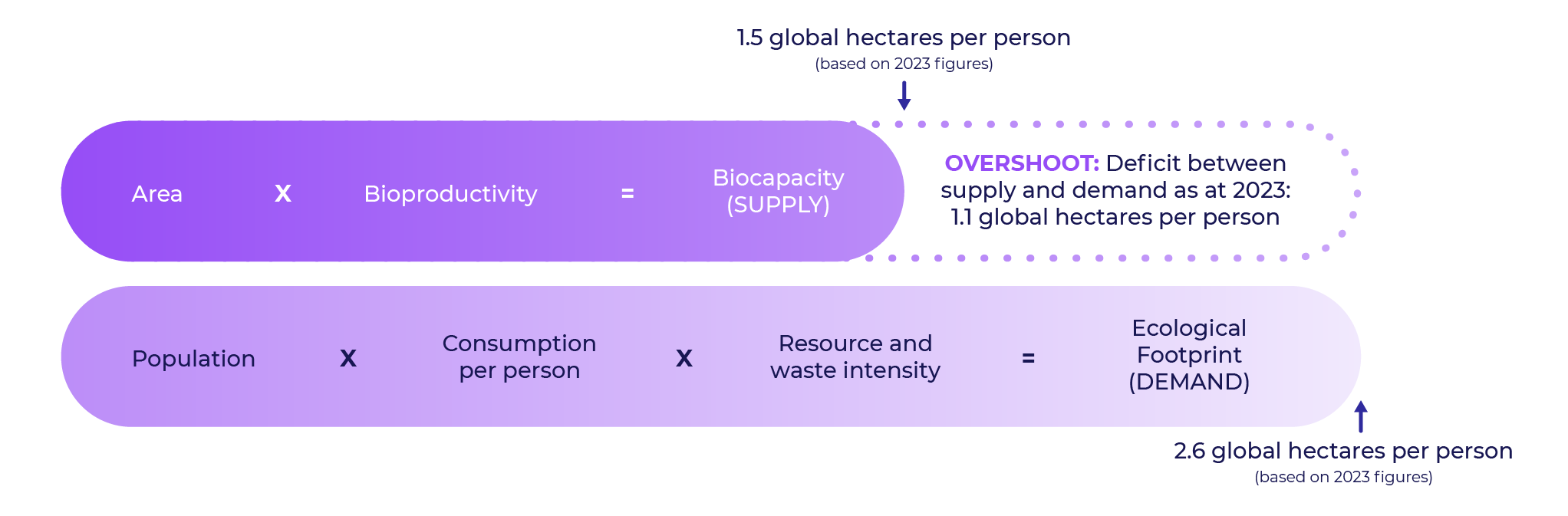
Our ecological footprints are based on the speed of consumption and the waste we generate compared to the speed in which nature can produce replacement resources and absorb the waste that we have disposed of (biocapacity). Five main measures of consumption and waste are taken into consideration being: energy, settlement, timber/paper, food/fibre and seafood which are compared to carbon footprint, built-up land, forests, cropland/pastures and fisheries.
A standard unit of global hectares is used to measure and compare both the ecological footprint and biocapacity. Biocapacity per person in 2023 was 1.5 global hectares whereas the average footprint was 2.6, resulting in an overshoot of 1.1 global hectares per person.
Ecological Debt in Business Terms
Globally we are in ecological debt as consumption is outstripping supply. July 30th marks the day when humanity will have consumed nature’s 2026 budget so, to put in business terms, we will be operating “in the red” thereafter. The gap is widening as Overshoot Day was 1st August last year. In fact, the last time that we were living within our means, biocapacity speaking, was in 1972 when Earth Overshoot Day was 31st December.
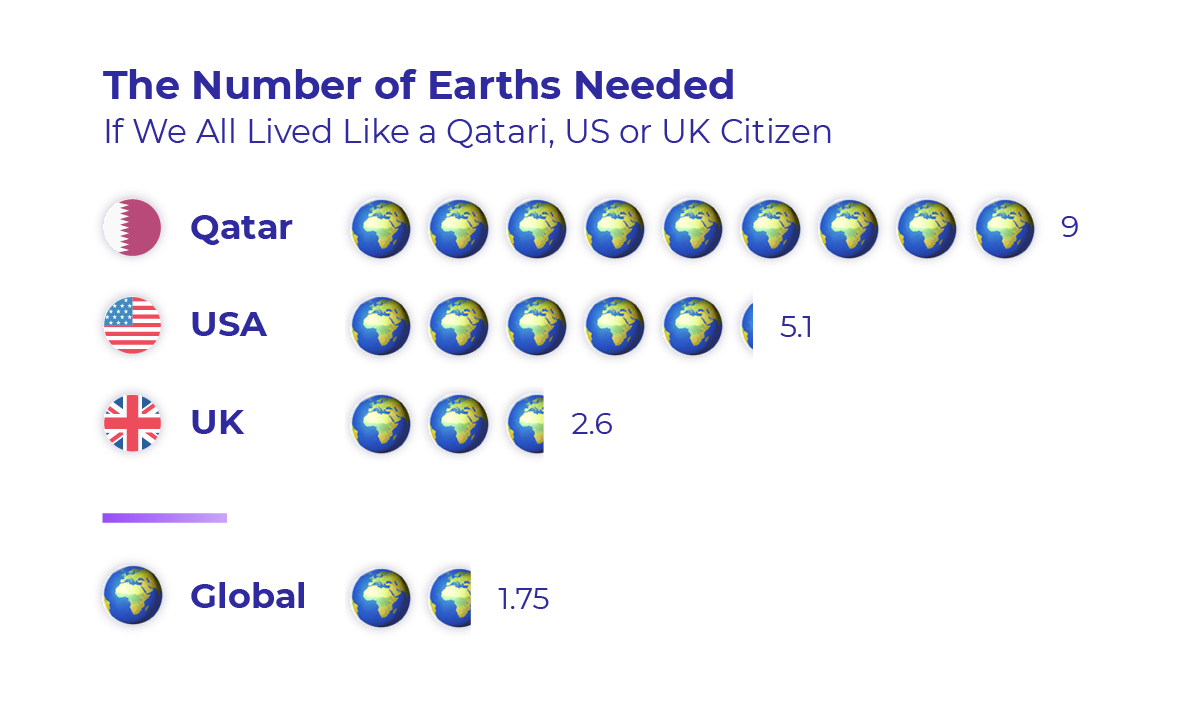
Some countries consume much more than others and lack the necessary natural resources to balance their books. The UK’s Overshoot Day was 20th May, the USA’s 13th March and Qatar’s February 6th. This is in sharp contrast with Uruguay whose overshoot Day is 17th December. If everyone on the Planet lived like the average UK citizen, we would need 2.6 Planet Earths; 5.1 Earths if we all lived like the average USA resident, and a whopping 9 Earths to live like an average Qatari resident. Globally, we require 1.75 Earths to live sustainably, but there is only one Planet Earth.
Businesses would not usually survive if their financial balance sheets were consistently “in the red”. The same principles of good business should be applied to nature and there are ways that we can reduce our overshoot by consuming less and increasing nature’s capacity.
How Can Businesses Reduce Their Natural Resource Consumption?
There are many options open to businesses to align their policies and strategies to reduce their ecological footprints and increase biocapacity if sustainability is at the heart of decision-making. Advancements in technology and infrastructure can help in reaching these goals.
For example, reducing reliance on fossil fuels and using renewable energy may not only reduce carbon footprints, but can also avoid destruction of land through mining for coal oil and gas, hence biocapacity is not lost. Energy efficiency savings such as insulating buildings, switching off electrical appliances and lights when not in use and using energy efficient machinery reduce consumption.
Circular Economies
Adopting a circular economy or at least recycling components so that precious metals and minerals are kept “in the loop” also avoids potentially destructive mining. A local example is the pioneering technology which is being trialled at the Royal Mint in Llantrisant to retrieve and reuse precious metals including gold from electronic waste.
Waste Reduction
When businesses only buy what they need, demand is reduced, and waste is avoided which can ensure biocapacity is not impacted to provide unwanted goods. An estimated 1.3 billion tons of food is wasted globally each year, representing about one-third of food production. The waste can occur on the farm, during distribution, at the wholesaler or retailer and in consumers’ homes.
AI Data Monitoring
How to avoid food waste does of course depend upon the industry, but AI technology is helping. For example, Nestle is trialling an AI tool that provides real-time data in monitoring and tracking products aiming to design waste out of the production process with the intention of saving 700 tonnes of edible surplus food.
Support Biodiversity
In addition to reducing demand, businesses can get involved with increasing biocapacity which can sometimes be a legal requirement. For example, in England, developers must deliver biodiversity net gains (BNG) of 10% per development pursuant to a biodiversity gain hierarchy. For example, if a tree is felled during the construction process, the loss must be compensated for in addition to creating a further 10% of biodiversity. Preferably, this is done by introducing or enhancing habitats on site, or if not possible, off-site units can be bought. As a final resort, statutory biodiversity credits must be bought.
Build Outdoor Spaces
If businesses have outdoor areas, these could potentially be rewilded, or native, pollinator friendly plants, flowers or trees can be planted. Companies can support staff volunteering to enhance or create local green spaces and collaborate with their value chains to stop and restore nature loss.
These are just a handful of suggestions. If you are Interested in learning more, you can calculate your own footprint.
Where Can Businesses Learn More About Reducing Ecological Debt?
The ISEP Foundation Certificate in Environmental Management is a great starting point for individuals looking to understand more about ecological footprinting and reducing organisational impact on the environment. For more information about any other environmental courses we offer, you can browse our full environmental course library below.
Alternatively, to find out more about related topics and discussion points, you can view any related environmental content via the Astutis Knowledge Hub below.
Related Blogs
-

Glossary for Decarbonisation Phrases & Terminology: Breaking Down the Jargon
Read through our full glossary of decarbonisation and sustainability terms, so you can cut through the industry jargon and understand key environmental topics.25.06.25 -
Key Performance Indicators (KPIs) in Sustainability | Business Guide & Benefits
Take a sneak peek into our IEMA Pathways to Net Zero course by finding out what environmental KPIs you need to be tracking to ensure success in your business sustainability and environmental goals.23.06.25 -
How Businesses Can Reduce Their Plastic Pollution | UNEP World Environment Day
Find out how businesses can reduce plastic pollution and the key policies and legislation that governs them.02.06.25 -
Environmental Protection Act 1990 Explained | Legislation Summary
Find out about one of the primary pieces of environmental legislation in the UK that governs pollution prevention, disposing of controlled waste, contaminated land management and statutory nuisances.27.03.25 -
How to Recycle in the Workplace | 10 Office Recycling Tips
Establish a robust system for recycling in your workplace by using our expert tips for getting started - with some suggestions for initiatives you can follow.13.11.24 -
Clean Energy Investments Nearly Double the Investment in Fossil Fuels
Find out why investments in clean energy are nearly double the investments made in fossil fuels across the planet – as well as which economies are investing the most.16.07.24

Real Life Stories

