







How We Can Reduce Food Waste and Food Loss | United Nations
Did you know that a staggering one-third of all food produced globally is wasted? The United Nations International Day of Awareness on Food Loss and Waste Reduction is a call to action for businesses, governments, and consumers to collaborate in reversing this alarming statistic and strengthening food security.
Food loss and waste (FLW) is defined by the United Nations Food and Agriculture Organisation (FAO) as “the decrease in quantity or quality of food along the food supply chain”. Food loss is a consequence of actions and decisions by upstream food suppliers, whereas food waste results from the “purchasing decisions by consumers, or decisions by retailers and food service providers that affect consumer behaviour”.
In the UK, the Waste and Resources Action Programme (WRAP) has simplified the definition so that food waste covers all stages of the supply chain, which is the terminology we have adopted in this blog.
So, why should we care about food waste, and what can we do to reduce it?
Why We Should Care About Food Waste
In a recent report, UK Food Waste & Food Surplus – Key Facts, WRAP estimated that in the years 2021–2022, post-farm waste in the UK amounted to 6.1 million tonnes. To put this in perspective, a small car weighs about one tonne. As depicted in the following chart, most of this waste is generated by households.
UK post-farm food waste by sector in million tonnes (Mt), 2021/2022:
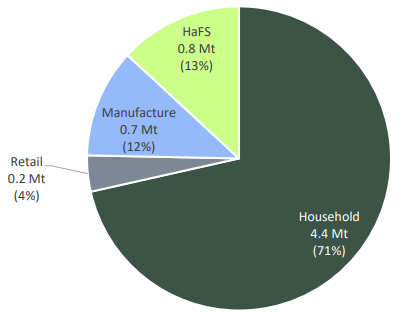
In fact, UK households are responsible for discarding an estimated 2.7 million potatoes, 2 million carrots, and 970,000 bananas every single day. WRAP suggests that over-purchasing and poor storage behaviour have compounded the problem.
The financial value of post-farm food waste in the UK is believed to be a staggering £22.3 billion per year.
Even though so much food is wasted in the UK and internationally, approximately 29% of the global population, some 2.33 billion people, were moderately or severely food insecure in 2023.
Industrial food production also comes at a cost to the environment as it can affect biodiversity and deplete natural resources. It also contributes to anthropogenic climate change if fossil fuels are relied upon for energy production and chemical fertilisers are used.
Burning fossil fuels produces carbon dioxide, and chemical fertilisers can drive nitrous oxide emissions. Nitrous oxide is a greenhouse gas estimated to be 273 times more potent than carbon dioxide (United Nations 6th Assessment Report). Soil sequesters carbon, so disturbing it by ploughing fields to plant crops also releases carbon.
When food waste decomposes, it creates methane, another greenhouse gas that is approximately 27 times more potent than carbon dioxide, but with a shorter atmospheric residency time (around 10-12 years) compared to carbon dioxide (5-200 years). Tackling methane emissions at scale by reducing food waste could significantly help reduce greenhouse gas emissions relatively quickly.
As it stands, food waste is responsible for generating 11% of global greenhouse gases Jolting food waste with electricity releases it's potential and if food waste were a country, it would be the third highest emitter of greenhouse gases after China and the USA.
Potential Solutions to Reduce Food Waste
The food material hierarchy provides guidance on how food should be handled to prevent waste, with disposal being the least favoured option.
Food and Drink Material Hierarchy
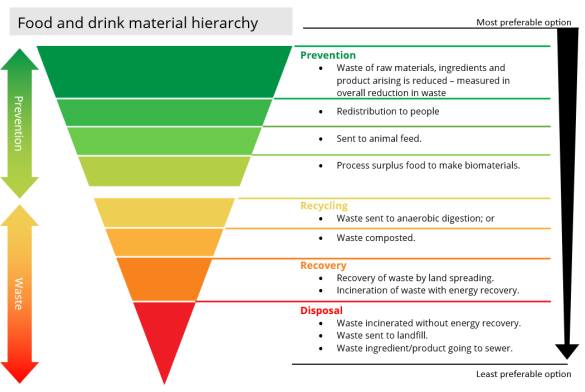
Preventing waste at scale would require extensive collaboration to ensure that households know how to use the food they have and that good, surplus food is redistributed effectively. A recent ISEP article outlined that the UK government is consulting with farmers to develop a national food strategy, which will involve devising a roadmap for farming and a land-use framework.
In addition to protecting nature and combating climate change, this initiative should also enhance the nation’s health. Preventing food waste would be a fundamental component to add resilience to any food strategy.
Food manufacturers and retailers can raise awareness and help their customers to buy only what they need and to store it effectively. Research conducted by Love Food Hate Waste found that if apples, bananas and potatoes were sold loose, a massive 60,000 tonnes of food would be saved every year, the equivalent weight of about 60,000 small cars. Enabling consumers to buy loose fruit and vegetables could have the added benefit of reducing the amount of packaging used.
WRAP has also provided guidance and highlighted the role of collaboration and successful initiatives, finding that the effective use of labelling can have wide-ranging implications. Arla’s groundbreaking campaign for customers to ‘Enjoy Me For Longer’ helped to raise awareness that if dairy products are stored correctly, they can be consumed after their best-before dates. Similarly, Aldi has reported the impact of changing their use-by date to best-before date on milk. Further examples of business collaboration can be found on the WRAP website.
If You're Not in the Food Industry
Even if your business is not part of the food industry, it can collaborate with catering suppliers when entertaining staff and clients to order only what is required and ensure that any surplus food is redistributed effectively. Companies could also get involved with Food Waste Action Week, held each March, and raise awareness among staff, which could trigger discussions and collaboration on how to reduce food waste at home.
Whilst preventing food waste is a priority, scientists have found that food waste can be saved from landfill and used in the production of biodiesel, car tyres or platform chemicals. These platform chemicals can be used in several industries, including pharmaceuticals, agriculture and packaging.
Furthermore, bio-oil produced from waste corn husks, wood chips and switchgrass could be used to plug uncapped oil wells. The bio-oil would be produced through pyrolysis and injected into underground oil wells. If successful, this would not only potentially save the waste crops from landfill, where they would decompose and emit methane, but also act as a carbon store. The uncapped oil wells would also cease to emit greenhouse gases, and safety concerns would be alleviated.

Environmental Insights
-
How Your Business Can Reduce Natural Resources Consumption | World Overshoot Day
Find out the primary ways that businesses can reduce their ecological date to ensure the longevity of their organisation whilst reducing their environmental impact.24.07.26 -
Key Performance Indicators (KPIs) in Sustainability | Business Guide & Benefits
Take a sneak peek into our IEMA Pathways to Net Zero course by finding out what environmental KPIs you need to be tracking to ensure success in your business sustainability and environmental goals.23.06.25 -
Common Causes of Air Pollution and How to Eliminate Them | Legal Requirements
Find out the most common causes of air pollution and how to prevent them including a guide on UK legal requirements for businesses.17.06.25 -
How Businesses Can Reduce Their Plastic Pollution | UNEP World Environment Day
Find out how businesses can reduce plastic pollution and the key policies and legislation that governs them.02.06.25 -

The Truth About AI & The Environment: Pros and Cons
Discover the positive and negative effects of AI on the environment, and understand the future implications of it's increased use in our day-to-day lives.30.05.25 -
Do Consumers Prefer Sustainable Businesses and Products?
Discover why more consumers are picking environmentally aware businesses that have strategies for improving sustainability and reducing their environmental impact.23.05.25

Real Life Stories

